Coverage area and geographic reach

Our coverage area includes all of Germany and Austria. We coordinate jobs on motorways, federal roads, regional roads, in industrial areas, at loading and unloading points, and in logistically important regions. This includes major freight corridors, industrial hubs, port and terminal regions, and locations where heavy transport, Ro-Ro (Roll-on/Roll-off) traffic, and ferry connections play an important role.

We organize call-outs across the main economic and logistics regions of Germany, including North Rhine-Westphalia, Bavaria, Baden-Württemberg, Hesse, Lower Saxony, Berlin, Saxony, and Hamburg.

This includes areas such as Duisburg, Cologne, Dortmund, Düsseldorf, Essen, Munich, Nuremberg, Ingolstadt, Stuttgart, Mannheim, Karlsruhe, Frankfurt am Main, Kassel, Hanover, Berlin, Leipzig, and Dresden.

A special focus lies on port and terminal regions, including Lübeck-Travemünde, Rostock, Kiel, Bremerhaven, Bremen, Cuxhaven, and the Port of Hamburg — all locations where international freight handling, Ro-Ro traffic, and ferry operations are part of daily logistics.

We also coordinate jobs in Austria, including important transport and business regions such as Vienna, Linz, Salzburg, and Graz. This allows us to organize suitable solutions for cross-border transport routes and international logistics operations.


What types of breakdowns and situations do we handle most often

Most often, truck towing is needed on the motorway: after a sudden breakdown, following an accident, when a lane is blocked, or when the vehicle can no longer continue safely. Even in heavy traffic, we can organize the right heavy recovery setup and carry out the job in line with safety requirements, taking into account vehicle weight, combination configuration, access to the vehicle, and any additional Absicherung that may be required. Depending on the case, this may involve a platform, crane, cable winches, hydraulic systems, underlift equipment, brackets, hydraulic jacks, and other specialized recovery tools.

A separate category is a vehicle in a ditch, on a slope, or off paved ground. This is no longer a simple towing job but a more complex recovery process: the vehicle must first be stabilized, safely recovered, and prepared for transport. If a truck is simply stuck in mud, snow, sand, or on a construction site, that is one type of case; if it has slid into a ditch at an angle, the risk of additional damage is higher and the technical setup changes completely.

In winter, common call-out reasons include black ice, loss of traction, skidding, sliding onto the shoulder, or being unable to move under your own power. In these situations, it is not enough to “just pull the truck out somehow.” We assess the position of the vehicle, its weight, its load, the risk of further sliding, and whether a safe recovery is possible. In some cases, a winch-based solution is enough; in others, a crane or additional stabilization is required.

We also handle vehicles after a fire. Even when the fire has already been extinguished, there may still be risks affecting the suspension, braking system, electrical system, fuel system, tires, and the overall condition of the frame or body. In such cases, we first assess whether the vehicle is still rollable, then determine whether the safest solution is an underlift, platform, partial loading, crane, or another controlled transport method.

Another common reason for calling a truck towing service is damage to the suspension, axles, hubs, steering, brakes, transmission, or blocked wheels. If the vehicle does not roll, standard towing is no longer suitable. It requires a different preparation process and different equipment. That is why we always clarify the type of damage in advance and organize the solution based on the real situation, not on a “standard call-out” approach.

If needed, we can also arrange transport of the vehicle to a workshop, parking area, or safe holding point, taking into account the vehicle type, load, and vehicle combination.


Basic rules for towing trucks, commercial vehicles, buses, and trailers

In heavy recovery, it is important to distinguish between emergency towing and planned transport. If the case involves a sudden roadside breakdown, the goal is to remove the vehicle from the danger zone and move it to the nearest suitable location: a parking area, workshop, or safe holding point. This is the logic behind how truck towing in Germany is organized.

For a tractor unit with a semi-trailer, the safest and most practical scenario is often to assess whether the tractor can be towed separately. In many cases, the semi-trailer is uncoupled and left at a safe parking location while the tractor unit is transported to a workshop. A separate solution is then organized for the trailer: another tractor may collect it, a partner service may reposition it, or it may remain in place until the main unit is back in service.

For an articulated combination with a trailer, the logic is similar: not every combination can or should be moved as a complete unit. In many cases, it is safer and more efficient to split the case into two parts: the truck separately, the trailer separately, and, if required, separate cargo transfer or repositioning.

Bus towing follows different rules from standard truck towing. Because of low ground clearance, long overhangs, and sensitive body elements, a bus cannot be moved using the same logic as a regular truck. In these cases, special lifting adapters, support systems, and fixation methods are used to avoid damage to the body, glazing, underbody, and attached components.

If axles, brakes, steering, transmission are damaged, or wheels are blocked, the first question is whether the vehicle can be moved at all. In some cases, the right underlift setup is enough. In others, partial loading, a platform, or a more complex heavy duty towing service is required. The same applies to vehicles that no longer roll after an accident or after loss of pressure in the system.

If the vehicle is in a ditch, on a slope, or off hard ground, the first stage is recovery and stabilization. Only after that comes the actual towing or transport. That is exactly why these cases differ in both cost and equipment from a standard roadside breakdown.


Why towing with another truck is less effective

The idea of “another truck can just pull us out” only sounds cheap until the first serious complication appears. A disabled commercial vehicle often has blocked wheels, damaged axles, steering failure, no air in the brake system, or transmission damage. Another truck does not solve those problems. It does not have a platform, crane, underlift, cable winches, hydraulic jacks, specialist brackets, or the equipment needed to prepare the vehicle safely for transport.

There is also the organizational side. Improvised towing by another truck does not solve issues related to Absicherung, police involvement, Autobahnmeisterei, trailer handling, parking, delivery to a workshop, or company documentation. What looks cheaper at first often ends up costing more in time, risk, and follow-up work — and often leads to a second call for a professional emergency towing service anyway.

In addition, towing with the wrong method can cause secondary damage to the suspension, transmission, prop shaft, body, or coupling system. For commercial vehicles, mistakes at this stage are often more expensive than arranging professional roadside assistance towing from the start.


Legal requirements for towing and recovery

When a breakdown happens on the motorway, the goal of towing is to remove the vehicle from the danger zone and take it to the nearest safe place or exit. This is not a format for “planned transport to wherever is most convenient” — it is an emergency measure. If the vehicle breaks down outside the motorway, it cannot simply be taken onto the motorway just because the route seems shorter.

During towing, traffic safety must be ensured at all times. Warning lights, the position of the vehicle, visible damage, access to the vehicle, and the risk to other road users all matter. If the breakdown, accident, cargo, or parts of the vehicle create a traffic hazard, police, road authorities, or additional Absicherung may be required.

For heavy commercial vehicles, it is not enough to look only at the fact that “the vehicle is broken down.” If the vehicle does not roll, if the wheels are blocked, or if the axle, steering, brakes, or transmission are damaged, that affects both the towing method and what is legally and technically permissible on the road. These are not situations where you can act using “car towing logic.” The correct transport method has to be chosen first, and only then can the work begin.

For combinations with trailers and semi-trailers, additional limits apply regarding length, maneuverability, and safety. That is why, in real operations, the tractor unit is often towed separately, while the trailer or semi-trailer is handled independently through uncoupling, repositioning, separate transport, or waiting for a replacement unit.


Our advantages

MT onroad gives foreign carriers one point of contact in Germany and Austria: request, price calculation, dispatch, ETA, and case completion — without unnecessary chaos. Instead of searching for local providers, trying to explain a breakdown in another language, and worrying after payment, you get one contact who manages the case from the first message to the end of the job.

We work 24/7, across Germany and Austria, with commercial vehicles from 7.5 to 60 tonnes — loaded and unloaded. This includes tractor units, trucks, buses, trailers, semi-trailers, and other heavy vehicles. We do not handle passenger cars (PKW). Our process is built specifically for heavy commercial transport.

One operator handles the case step by step: data collection, price calculation, payment confirmation, dispatch, ETA, work confirmation, and final status. That means after your request, you know what is happening now, what the next step is, and who is handling the case. After payment, the client is not left in silence — they receive updates, ETA, and, if required, a message for the police.

We agree truck towing costs in advance and do not add extra work to the invoice without approval. If only a more expensive option is available in a specific location, the client makes that decision. If the situation requires police, Autobahnmeisterei, or additional Absicherung, we explain this before dispatch, not after the truck is already on the way.

Another advantage is our response time of up to 5 minutes and our clear digital workflow: messenger communication, fixed process steps, and stored case history. This speeds up dispatch and reduces communication chaos for both the dispatcher and the driver.

If documents are needed for an insurance towing service or claim file, we can prepare and provide the relevant paperwork for the completed work and the incident itself. If required, we can also assist with temporary placement of the recovered vehicle during repairs — depending on the situation and through our partner network. After the case is completed, the history remains in the system, so during the next incident you do not have to resend all company details from scratch.

We work with the main European and international commercial vehicle brands, including Mercedes-Benz, MAN, Scania, Volvo, DAF, Iveco, Renault Trucks, Ford Trucks, Setra, and Neoplan.


How you can save money

Not every situation requires the most expensive urgent scenario. If the vehicle can safely remain on a parking area or in a safe zone, a planned next-day solution is often cheaper than a night emergency call-out without making the final result worse.

The second way to save money is simple: send precise information from the start — location, vehicle type, weight, load status, type of damage, whether the vehicle rolls, and whether there is a trailer or semi-trailer. The more accurate the information in the first message, the higher the chance that we can dispatch the right equipment immediately and avoid a second trip, unnecessary waiting time, or a more expensive recovery scenario.

Truck towing in Germany and Austria 24/7

Only for commercial vehicles from 7.5 t. Truck towing up to 60 t: tractor units, trucks, buses, trailers, semi-trailers, special vehicles, and low-floor vehicles.

Why do transport companies choose MT onroad when they need truck towing in Germany?

✅ Response within 5 minutes – a real person, not a bot.
✅ Clear process: request → price → payment → ETA → dispatch.
✅ 600+ partners across Germany – including nights and weekends.

  • When a truck, tractor unit, bus, trailer, or semi-trailer cannot continue after a breakdown, we organize transport to a workshop or the nearest safe parking area. We take into account rollability, suspension condition, and whether prop shaft service or work on the drive axle is required. For buses and low-floor vehicles, special adapters such as Bus-Brille are used.

  • For vehicles with damage to the frame, chassis, suspension, or blocked wheels after an accident. In more complex cases, recovery and preparation for safe transport come first, followed by the actual truck towing service.

  • When the vehicle is stuck in mud, snow, sand, on a construction site, or on a soft shoulder. Key factors include weight, load, winch pulling force, and the risk of tipping to the side.

  • For situations involving height differences, difficult angles, and a high risk of additional damage during extraction. It is not only about pulling force, but also about a safe recovery path, boom operation, and vehicle stability during the recovery.

  • For trucks and road combinations lying on their side or partially overturned. We take into account load shift, body structure, and the next recovery stage; in sensitive cases, lifting bag solutions may also be used.

Get offer

Need truck towing?

How the assistance process works with us


Request to truck towing service

24/7 at +49 97753769999
WhatsApp, phone, Telegram, callback, contact form
Tell the operator that you urgently need truck towing.

Describe the problem

Breakdown, accident, blocked braking system, vehicle rollover, or another situation.
Vehicle type / Weight and load / GPS from where / GPS to where / Photos of the situation.

Write in WhatsApp

Search for the right solution

We look for a solution in your area and you receive a quote and ETA — the estimated arrival time of the service team.

Payment

Payment by card via payment link or by bank transfer / payment confirmation for dispatch of the truck towing service.
 |  |  |  | Payment DKV


Truck towing service is on the way

Heavy vehicle recovery is carried out based on the specific situation and the requirements of road authorities and police.

Documents

When the work is finished, we provide a complete invoice for your accounting records.

And we also ask all customers to leave an honest review on Google


Calculate truck towing cost

Important!

On the motorway and in other dangerous locations, towing or recovery work may require separate traffic safety measures. If needed, we contact the police or Autobahnmeisterei and coordinate the safe execution of the work.

We are sure that we can offer a suitable solution in 95% of cases

Google reviews

01/00

What our Heavy-Duty Towing service Includes

After contacting us, you are never left searching for a solution alone. We manage the entire case through a clear process: data verification, price calculation, dispatch, and ETA tracking. No unexplained delays and no hidden work without your approval.

One Contact for Germany and Austria

You don't have to search for a local provider from scratch or repeatedly explain your breakdown. We organize a fast, market-based solution across Germany and Austria.

Price and ETA before dispatch

Before the job starts, you know the exact cost, payment terms, and expected arrival time. No surprises, no hidden fees.

From 7.5 to 60 t, Loaded or Empty

24/7 truck towing for tractor units, trucks, buses, trailers, and semi-trailers of all types — including car carriers, mega trailers, tankers, and low-loaders.

Complex cases without chaos

Left-lane incidents, motorway recovery, ditch extraction, blocked wheels, or difficult post-accident positions. If needed, we coordinate traffic safety (Absicherung), police, and Autobahnmeisterei.

How We Calculate Truck Towing Costs

There is no one-size-fits-all price for truck towing in Germany.

The cost of a heavy-duty towing service depends on the actual situation on site: where the vehicle is located, whether it can still roll, and whether the case requires simple towing or recovery and preparation for transport first.

Costs are generally higher if police or highway maintenance services (Autobahnmeisterei) are involved, or if traffic safety measures (Absicherung) are required. The same applies to accident sites, vehicles in ditches, locked wheels, damaged axles, or difficult-to-access locations.

We always verify the details, explain the cost drivers, and confirm the price before we deploy. If only a more expensive solution is available in your specific area, we will only proceed after your approval.

Factors affecting the cost:

1. The Vehicle & Situation 

  • Distance & Deployment: Travel time, mileage, site access, and traffic conditions (e.g., Autobahn vs. urban).
  • Vehicle Specifications: Gross vehicle weight (GVW) and load status (empty vs. loaded).
  • Vehicle Configuration: Tractor unit only, semi-trailer separation, or full truck-trailer combination.
  • Vehicle Status: Roadworthiness issues (accidents, locked wheels, axle/transmission damage, off-road).

2. The Recovery Process 

  • Service Scope: Simple transport vs. complex recovery (winching, ditch extraction, site stabilization).
  • Equipment Type: The type of recovery unit required, including multi-axle heavy-duty vehicles for complex cases.
  • Cargo Handling: Need for transloading, reloading, or specialized logistical support.
  • Additional Logistics: Secure storage, site safety (Absicherung), and standby time.

Specialized equipment required for your situation also affects the cost:

  • Bus-Brille (Specialized Underlift): A specialized lifting attachment used to safely lift and secure buses and heavy commercial vehicles during recovery and transport.

  • AWU 500 (Heavy-Duty Wrecker): A specialized unit with an underlift used when standard tow trucks cannot handle the weight or complexity.

  • Dolly-Achse: An auxiliary dolly used when wheels, axles, or suspension are damaged, preventing standard towing.

  • Kardanwellen-Service: Disconnecting or removing the driveshaft to protect the transmission during towing.

How to optimize costs?

If the vehicle is in a safe location, night-time emergency rates may not be necessary; scheduling for the morning can often be more cost-effective. Providing accurate information (photos, precise location, vehicle type, weight, and damage description) in your first message is the best way to avoid multiple trips, unnecessary waiting, or paying for the wrong equipment.

Why we don’t quote "prices starting from 99 €":

While a simple tractor relocation from a safe parking lot might cost a few hundred euros, recovering a loaded semi from an autobahn ditch can easily run into thousands.

We analyze the situation first, then provide a transparent price and ETA before deployment.

To provide the right solution quickly, please share the key details of your situation. We will contact you via WhatsApp or call you back and present the available options.

✔️ All quotes are calculated based on the data you provide.

✔️ We confirm the final cost before the service team deploys.

✔️ Accurate information minimizes the risk of additional costs.

Request your price now!

Why a truck must be removed from the motorway quickly after a breakdown

Fines & Regulations (Germany 2026)

Situation Fine* Points 
Illegal stopping on motorway 30 € 0
Illegal parking on motorway/express road 70 € 1
Stop due to lack of fuel or battery (negligence) from 35 € 0–1
Breakdown area not secured (no warning lights/triangle) 30 € 0
… with danger to others 60 € 1
… causing accident 75 € 1
Obstruction of traffic 60–75 € 1
Creating dangerous situation 75–100 € 1
Accident due to violation 100–120 € 1
Violation of towing rules 20 € 0

* Fine depends on consequences.

Legal basis

Practical insights

Regulations define obligations.
Fines usually result from wrong actions immediately after stopping.

Common mistakes:

👉 The longer the vehicle stays on the motorway:

  • the higher the fine risk
  • the higher the accident risk

➡️ Fast towing is not just about speed — it directly reduces financial losses.
Latest posts
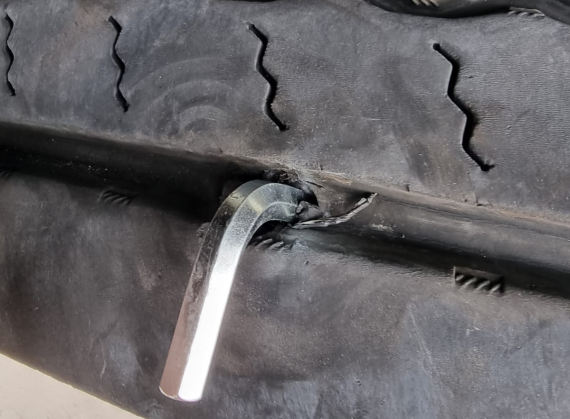
Emergency Truck Tire Repair on the Road: Procedures, Liability, and Options for the Driver
27/11/2025
Emergency Truck Tire Repair on the Road: Procedures, Liability, and Options for the Driver

Emergency truck tire replacement on the road is one of the most common situations handled by roadside assistance teams. Although this type…

Read more
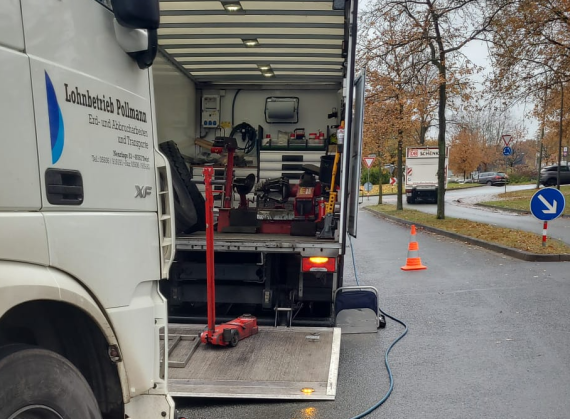
How much does it cost to replace tires on a truck?
20/11/2024
How much does it cost to replace tires on a truck?

The cost for truck tire replacement varies depending on the company and additional services. On average, it ranges from €150…

Read more
Changing a tire on the 1st axle of semi-trailer on right side on A27 motorway near Bremen
21/03/2023
Changing a tire on the 1st axle of semi-trailer on right side on A27 motorway near Bremen

At night, a customer from Poland called our hotline who was on a route in Germany. He had an urgent…

Read more
Changing rims and tires on a Scania truck trailer at Abbenrode next to the A36 autobahn
02/03/2023
Changing rims and tires on a Scania truck trailer at Abbenrode next to the A36 autobahn

Early in the morning at 6.00 a German freight forwarder called our service hotline and told us about a situation…

Read more
Do you have problems with a truck on route in Germany? Find out the possible solutions and the price
Share coordinates
Sending request...