

2025–2026 Guide to the truck manufacturers’ cartel: BGH IV–VI, EuGH rulings and real Chances of compensation for carriers





The so-called European truck cartel case remains among the largest and most influential competition law proceedings ever pursued within the EU. Over many years, the European Commission uncovered systematic price coordination among major truck manufacturers and consequently imposed fines exceeding €3.8 billion.
Between 1998 and 2011, leading producers such as Scania, Daimler, MAN, Iveco, Volvo/Renault, and DAF were found to have jointly increased truck prices while claiming compliance with the Euro 3–6 emissions standards.
Recent decisions by the German Federal Court of Justice (BGH), the Court of Justice of the European Union (EuGH), and the European Commission have significantly reshaped the legal framework for affected companies.
As a result, any haulage or logistics operator that bought or leased trucks in Germany between 1998 and 2014 may now pursue financial redress for the artificially inflated prices caused by this long-running cartel.
MT Onroad, in cooperation with the antitrust specialists of IGVR Rechtsanwälte, has already achieved successful outcomes in numerous related cases across Germany and continues to assist claimants in recovering truck cartel compensation.
This article summarises the latest EuGH and BGH rulings and outlines how these judgments open new avenues for restitution claims in the 2025–2026 period.
|
Check whether your truck is eligible for compensation by clicking the "Calculate the possible compensation amount" button.
What is the truck manufacturers’ cartel, and why is it still under legal discussion?
Between 1998 and 2011, Europe’s major truck manufacturers — MAN, Daimler, DAF, Iveco, Volvo/Renault, and later Scania — secretly coordinated their pricing over more than a decade. They aligned prices for trucks over six tons, agreed on surcharges and discounts, and synchronized the introduction of stricter emission standards.
This collusion violated EU competition law (Article 101 TFEU), which forbids agreements that restrict fair competition. Following an investigation, the European Commission confirmed the cartel and imposed fines totaling over €3.8 billion.
MAN avoided penalties by providing key evidence as a whistle-blower, while the other companies accepted sanctions, including a separate fine for Scania. The truck cartel remains the largest antitrust case in EU truck cartel history, serving as a landmark example of coordinated market manipulation.
| Manufacturer | Fine amount (€) | Source |
| MAN | Exempted (leniency) | European Commission decision of 19 July 2016, case AT.39824 – Trucks |
| Daimler (Mercedes-Benz Trucks) | 1 008 766 000 | European Commission decision of 19 July 2016, case AT.39824 – Trucks |
| DAF Trucks | 752 679 000 | European Commission decision of 19 July 2016, case AT.39824 – Trucks |
| Volvo Group / Renault Trucks | 670 449 000 | European Commission decision of 19 July 2016, case AT.39824 – Trucks |
| Iveco | 494 606 000 | European Commission decision of 19 July 2016, case AT.39824 – Trucks |
| Scania | 880 523 000 | European Commission decision of 1 February 2024, C-251/22 P |
In the official truck cartel European Commission documentation, it is confirmed that members of the truck manufacturers’ cartel not only coordinated pricing but also exchanged technical information, aligned production schedules for new vehicle models, and adopted unified rules for surcharges connected to environmental innovations.
These documents officially established the existence of the LKW cartel, forming the foundation for hundreds of court cases across Germany. They are now widely referenced by courts such as the BGH, OLG München, and others when reviewing carriers’ compensation claims.
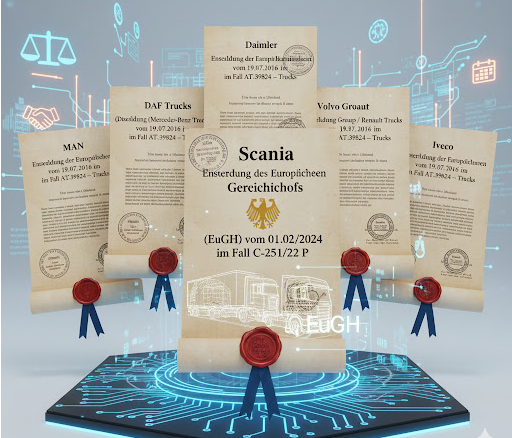
Court decisions (EuGH and BGH): how they reshaped the right to compensation
Following the European Commission’s 2016 decision (Case AT.39824 – Trucks), EU and German courts shifted their focus from proving that a cartel existed to determining how damages should be calculated and compensated.
The current legal interpretation is shaped primarily by five key rulings of the Court of Justice of the European Union (EuGH) and the German Federal Court of Justice (BGH).
EuGH, 01.02.2024 — C-251/22 P (Scania AB v. European Commission)
The EuGH upheld the €880.5 million fine against Scania AB, confirming that the manufacturer had participated in a “single and continuous infringement” of EU competition law. This judgment fully rejected Scania’s appeal and is now considered definitive proof of its involvement in the cartel.
Implication for claimants: there is no longer any requirement to prove the existence of the infringement, as it has already been legally confirmed at the EU level.
- Full text of the ruling (01.02.2024): C-251/22 P, Scania AB v. European Commission.
- Alternative source: Eur-Lex — Summary of Judgment.
BGH, 09 July 2024 — KZR 98/20 (LKW-Kartell IV)
In this decision, the BGH clarified how § 287 ZPO should be applied in cartel compensation cases. The court decided that judges may estimate the amount of price overcharge using available market data — without requiring complex econometric models or expert simulations.
This substantially lowers the burden of proof for plaintiffs: they only need to demonstrate that they purchased or leased trucks between 1998 and 2014 to be eligible for compensation.
What this means for the claimant: proving the amount of overpayment now requires far less evidence than before.
- BGH judgment of 09.07.2024
Federal Court of Justice, October 1, 2024 — KZR 60/23 (Truck Cartel V)
The BGH expanded this legal approach to include leasing and hire-purchase (Mietkauf) contracts, officially recognising that these ownership forms also qualify for compensation.
What this means for plaintiffs: the right to claim damages now extends beyond direct purchasers — it also covers lessees and those using hire-purchase agreements.
BGH, April 8, 2025 — KZR 71/23 (LKW-Kartell VI)
In its judgment of 8 April 2025, the BGH reaffirmed the so-called “Erfahrungssatz” principle, an empirical rule that assumes prices under cartel conditions are consistently higher than in competitive markets.
What this means for plaintiffs: the court recognises the presumption of inflated prices under cartel circumstances, relying on the empirical rule, which further strengthens the claimant’s position when damages are being calculated.
- BGH decision summary (Leitsätze) – Urteil des Kartellsenats vom 8.4.2025 – KZR 71/23 – LKW-Kartell VI
- Full text of the decision
CJEU, 04 September 2025 — C-21/24 (limitation period guideline for follow-on claims)
For follow-on claims, the limitation period begins once the competition authority’s decision becomes final.
What this means for plaintiffs: in many situations, the time limits for submitting claims have been extended; however, the precise period depends on the individual case and must be verified through a document review.
Summary
Collectively, these rulings form the foundation of current LKW-Kartell case law:
- EuGH (01.02.2024) — finally confirmed Scania’s liability.
- BGH IV (09.07.2024) — clarified the interpretation of §287 ZPO and simplified damage calculations.
- BGH V (01.10.2024) — extended compensation rights to leasing and hire-purchase.
- BGH VI (08.04.2025) — reaffirmed the empirical rule principle and extended compensation rights to leasing and hire-purchase cases.
Thanks to these precedents, the truck cartel claim procedure has evolved into a reliable, practical instrument for protecting the financial interests of carriers and transport companies across the European Union.
Who is entitled to compensation?
| Parameter | Criterion | Official basis / source |
| Type of vehicle | New and used trucks with a total weight of 6 tonnes or more (all classes — medium and heavy), purchased within the EEA | Summary of the Commission’s decision dated 19.07.2016 (AT.39824 — Trucks) |
| Purchase period | 1998 - 2014 | Same source – section 2.3 |
| Manufacturers (addressees) | MAN, Daimler, Volvo/Renault, Iveco, DAF (2016 decision) and Scania (additional decision 2017) | Same source – section 2.2 |
| Form of ownership | Kauf (purchase) / Leasing / Mietkauf (hire-purchase) — all forms are recognized as a valid basis for compensation | Solution BGH KZR 60/23 (LKW-Kartell V)dated 01.10.2024 — confirmed that cartel overcharges also affect leasing rates; BGH KZR 71/23 (08.04.2025)— recognized leasing and hire-purchase rights to compensation. |
| Proof of damages | The court assesses damages under § 287 ZPO based on available data (no mandatory econometrics) | Solution BGH KZR 98/20 (LKW-Kartell IV) от 09.07.2024— interpretation of § 287 ZPO. |
| Required documents | Invoice, purchase or leasing contract, vehicle registration documents | General BGH practice under § 287 and guidelines from LKW-Kartell VI (2025). |
How do courts assess a company’s damages in the truck cartel case?
- The fact of infringement is already established by rulings of the European Commission and EuGH, so no additional proof of violation is necessary.
- The claimant must provide documentation such as the invoice (Rechnung), purchase or leasing contract (Kaufvertrag / Leasingvertrag / Mietkaufvertrag), and vehicle registration details.
- The court then determines the fair market value by analysing manufacturers’ price lists, market reports, and statistical data, comparing them with similar transactions involving non-cartel vehicles.
- Under § 287 ZPO, and following BGH methodology, the estimated overpayment is typically calculated at 5–15% of the vehicle’s purchase price.
- If evidence is incomplete, the court applies the “Erfahrungssatz” judicial estimation principle — using average market indicators and the transaction period — to determine a realistic compensation value. As a result, damages can reach €6,000–10,000 per vehicle.
Limitation periods for damage compensation claims
Under §§ 195–199 BGB, the general limitation period for compensation claims is three years from the end of the year when the claimant became aware of the infringement and the liable party’s identity. However, it cannot exceed ten years from the date of the damage itself.
In the truck cartel legal action, this period has repeatedly been suspended because of extended proceedings before the European Commission, European Court of Justice (EuGH), and Federal Court of Justice (BGH). As a result, the effective filing deadlines have been prolonged beyond the standard three-year term.
- For Daimler, MAN, Volvo/Renault, Iveco, and DAF, the limitation period started with the European Commission’s decision of 19.07.2016 (AT.39824 – Trucks). Taking into account suspensions caused by appeals and collective cases, claims remain valid until approximately the end of 2026.
- For Scania, a separate ruling dated 27.09.2017 applies, with the limitation suspended until the EuGH C-251/22 P decision on 01.02.2024. Thus, claims can realistically be filed until around 2027–2028.
- For leasing and hire-purchase contracts, the final legal position was defined in BGH KZR 60/23 (01.10.2024) and KZR 71/23 (08.04.2025). Accordingly, claims for these types of ownership may be submitted up to 2028–2029, depending on individual case details.
These terms serve as practical guidelines derived from legal precedent and suspension periods — the precise calculation always depends on the specific facts of each claim.
Collective and individual claims in the LKW-Kartell case: how carriers obtain compensation in Germany
Transport companies affected by the RHA truck cartel can pursue compensation in two main ways — through an individual legal claim or by joining a collective action (Sammelklage). Both options are officially recognised under German law and are widely used in proceedings involving automotive cartels.
Individual claims are submitted directly on behalf of a transport company. This path is often chosen by large carriers operating extensive fleets, where potential damages are substantial. Legal representatives prepare an individual package of evidence and file it with the competent Landgericht (regional court), which then examines the claim on a case-by-case basis.
Collective claims combine the demands of multiple companies, allowing them to share costs and streamline the legal process. In practice, this approach is most frequently used in the truck cartel case, as it significantly reduces expenses and expedites proceedings.
MT Onroad collaborates with antitrust specialists from IGVR Rechtsanwälte and partner law firms experienced in competition litigation, following the approach proven by BGL and Hausfeld Rechtsanwälte in Germany — representing the interests of more than 7,000 carriers as of 2024.
These proceedings are based on the assignment of claims model, where the carrier transfers its right to compensation to a legal representative. This mechanism is legitimate under German law and confirmed by court practice pursuant to §33 GWB (Act Against Restraints of Competition). All participants of the cartel bear joint and several liability, meaning compensation can be recovered in full from any of the manufacturers — Daimler, Volvo/Renault, Iveco, DAF, MAN, or Scania — according to §421 BGB.
How to apply for compensation: a step-by-step guide for truck buyers
If you purchased or leased a truck between 1998 and 2014, you might qualify for partial reimbursement under the LKW-Kartell case. The compensation procedure is well-established — you only need to collect the required documents and follow several simple steps.
- Check eligibility. Ensure that your truck:
- belongs to one of the following brands: Daimler, MAN, Volvo/Renault, Iveco, DAF, Scania;
- has a total weight of at least 6 tonnes;
- was bought for €30,000 NET or more;
- was purchased, leased, or taken under a buyout agreement between 1998 and 2014.
- If these conditions apply, you are entitled to compensation.
- Prepare your documents. You will need:
- an invoice or purchase/lease/hire-purchase contract;
- the vehicle registration certificate or technical passport;
- if available, payment confirmations or duplicate invoices.
- These materials are enough to start the preliminary legal review.
- Estimate your compensation. Use the MT Onroad calculator on this page to receive an initial estimate based on BGH precedents. On average, reimbursement ranges between 5-15% of the original purchase price plus interest accrued since 2011.
- Submit your documents. To maintain confidentiality, contact MT Onroad via the feedback form to receive detailed instructions. Your materials will be reviewed by IGVR Rechtsanwälte, experts in antitrust compensation.
- Receive the assessment and sign the representation agreement. After the legal review, our partners will:
- confirm that your case meets the compensation criteria;
- calculate the realistic compensation amount and chances of recovery;
- If the case is valid, prepare a representation agreement for further legal action.
The process is conducted entirely remotely. Filing documents does not require personal attendance in Germany — your appointed lawyer represents your interests under a power of attorney. The sooner you submit your documentation, the higher your chance to include your case in the 2025–2026 compensation rounds.
In 2025, German courts continue to process both individual and collective compensation claims under the LKW-Kartell framework, offering real recovery opportunities for transport companies.
Frequently Asked Questions about the LKW-Kartell
1. How long does it take to receive compensation?
The average duration depends on the complexity of the case and the court’s workload. In most cases, the legal review and submission take a few weeks, while the court procedure itself may last from 12 to 24 months.
2. Do I need to appear in court personally?
No. All communication with the court is managed by authorized legal representatives under a power of attorney. The process is entirely remote for foreign companies and EU carriers.
3. Is there any risk or cost if the claim is unsuccessful?
No upfront fees are charged. MT Onroad’s partner law firms usually work on a success-fee basis, meaning you only pay a small percentage of the recovered amount once compensation is awarded.
4. What happens if my company has merged or changed its name since purchasing the truck?
That’s not a problem. As long as you can prove legal succession (for example, through merger documentation or tax records), the right to compensation remains valid.
5. Are used trucks covered by the claim?
Yes, provided that the truck was originally manufactured or first sold during the cartel period (1998–2014) and falls under one of the affected brands.
6. Can foreign companies outside Germany also apply?
Yes. Carriers from any EU country that purchased or leased trucks in Germany during the relevant period are eligible. The claim is handled in German courts with legal representation provided locally.
7. What if the purchase was financed through a bank or leasing company?
The claim can still be submitted. The BGH confirms that the overpayment impacts all parties within the transaction chain, including leasing customers. Your existing contract documents are sufficient to substantiate the claim.
8. How is the compensation calculated?
Based on § 287 ZPO and BGH precedents, courts typically recognize an overpayment between 5 and 15 percent of the truck’s original net price, plus interest since 2011.

Useful info updates via Telegram Subscribe to the Telegram Bot and get:
- Current news about the traffic situation in Germany
- Emergency help for your truck - just send HELP to the bot
 Truck Breakdown and Heavy Recovery in Germany: How Fleet Managers Can Control Towing, Recovery and Costs
 A truck breakdown in Germany is rarely just a technical problem. For fleet managers and dispatchers, it immediately creates a…
Read more Thermodynamics and tribology of tyre aging: mechanisms of heat generation and structural degradation
 1. Introduction: the tyre as a thermodynamic systemA pneumatic tyre is a sophisticated composite structure designed to operate under extreme…
Read more Truck vs Passenger Tyres: Structural Differences, Production Logic, and Regulatory Framework
 Physico-Chemical Foundation: the process mechanismthe operation of any pneumatic tyre is based on the phenomenon of hysteresis, which is a…
Read more