

Thermodynamics and tribology of tyre aging: mechanisms of heat generation and structural degradation





1. Introduction: the tyre as a thermodynamic system
A pneumatic tyre is a sophisticated composite structure designed to operate under extreme cyclic loads. unlike rigid mechanical components, its behavior is governed by the viscoelastic properties of rubber compounds reinforced with high-strength steel cord and textile materials. the primary factor limiting the service life and reliability of a tyre is thermal aging — an irreversible process of material degradation caused by cumulative heat exposure.
Understanding the mechanisms of heat generation and aging requires viewing the tyre not merely as an elastic body, but as a thermodynamic system: in this system, the mechanical energy from the engine is continuously converted into thermal energy through hysteresis losses. this process is aggravated by operational variables such as load, speed, internal pressure, and ambient temperature. this report provides an exhaustive analysis of the physicochemical processes underlying thermal aging, their impact on structural integrity, and the economic consequences for vehicle operation.
1.1 Relevance of the thermal aging problem
In today's transport industry, the demand for tyre efficiency and durability is constantly increasing. higher transport speeds, increased axle loads, and the drive for fuel economy create conditions where tyres operate at elevated temperatures. thermal aging is the "silent killer" of tyres: it does not always manifest as external damage until a catastrophic failure occurs, such as tread separation or casing rupture. research and manufacturer data show that tyres exposed to prolonged high temperatures (e.g., in hot climates) exhibit significantly higher failure rates compared to those operated in moderate conditions. this confirms that the temperature factor is the dominant driver in the degradation of rubber products.
2. Physics of heat generation: viscoelasticity and hysteresis
To quantify the sources of heat, one must describe the internal physics of the rolling tyre. heat is generated predominantly internally due to the viscoelastic behavior of the rubber compounds.
2.1 The nature of polymer viscoelasticity
Rubber is a viscoelastic material, exhibiting characteristics of both an elastic solid and a viscous liquid.
Elastic component: similar to a spring, the polymer network stores energy during deformation and returns it when the load is removed.
Viscous component: like a liquid, molecular chains experience internal friction, leading to energy dissipation in the form of heat.
The portion of energy lost during each deformation cycle is known as hysteresis.
2.1.1 Mechanism of molecular friction
At the microscopic level, hysteresis is caused by the friction of molecular chain segments and their interaction with fillers like carbon black or silica. during deformation, the polymer matrix rearranges, breaking and reforming weak physical bonds. this process (the Payne effect) requires energy, which is converted into heat. since polymers have low thermal conductivity, this energy cannot dissipate quickly, leading to localized overheating in massive zones such as the shoulder and the bead core.
2.2 Mechanical loss tangent ($\tan \delta$)
The key parameter for heat generation is the mechanical loss tangent ($\tan \delta$): this is the ratio of the loss modulus ($E''$) to the storage modulus ($E'$):
$$\tan \delta = \frac{E''}{E'}$$
High $\tan \delta$: means intense heat generation. it is typical for tread compounds optimized for road grip but is undesirable for internal layers.
Low $\tan \delta$: indicates low heat generation, which is critical for breaker and carcass rubbers to extend service life.
2.3 Non-uniformity of thermal fields
Heat generation is distributed unevenly throughout the structure:
Tread: subjected to cyclic compression.
Sidewall: experiences bending deformations, the amplitude of which depends on pressure.
Shoulder zone: this is the zone of maximum thermal stress, where compression and interlaminar shear combine.
3. Chemistry of thermal aging: mechanisms of degradation
Heat acts as a catalyst for irreversible chemical changes in the tyre structure.
3.1 Thermo-oxidative degradation
Oxygen diffuses into the rubber, and high temperatures accelerate its reaction with the polymer. this process follows a free-radical mechanism, leading to two outcomes:
Reversion (softening): characteristic for Natural Rubber (NR). polymer chains break, making the rubber sticky and reducing its strength.
Hardening: characteristic for Synthetic Rubbers (SBR). excessive cross-linking occurs, increasing the material's stiffness and brittleness, which leads to cracking.
3.2 Evolution of sulfur bonds
During aging, polysulfide bonds ($-S_x-$) that provide elasticity break down and rearrange into shorter, rigid monosulfide ($-S-$) bonds.
Consequences: the material loses fatigue resistance.
Impact on the breaker: hardening of the rubber between breaker layers prevents it from compensating for shear stress, provoking delamination.
3.3 Arrhenius kinetics
The rate of aging depends exponentially on temperature according to the Arrhenius equation. a $10^{\circ}C$ increase in operating temperature can roughly halve the rubber's remaining life.
4. Operational factors: interaction model
The thermal regime is formed by the interaction of load, speed, and pressure.
4.1 Internal pressure and mechanics of deflection
Underinflation: increases sidewall deflection. since hysteresis depends on deformation amplitude, an underinflated tyre acts as a "thermal multiplier".
Pressure rise from heat: as an empirical rule, pressure rises by approximately 2 PSI for every $10^{\circ}F$ ($5.5^{\circ}C$) of heating in truck tyres.
4.2 Impact of load (overloading)
Overloading increases the contact patch and total deformation, linearly raising heat generation. it also creates excessive tension in the cord, increasing the risk of ruptures.
4.3 Speed
Speed increases the frequency of deformation cycles. at high speeds, heat generation outpaces dissipation, leading to cumulative heating.
Table 1: Influence of factors on thermal regime
Factor | Change | Mechanism of action | Result |
Pressure | -20% from nominal | increase in sidewall deformation amplitude | critical overheating, casing destruction |
Load | +20% from nominal | increase in the volume of deforming rubber | accelerated aging, risk of separation |
Speed | High | increase in hysteresis cycle frequency | internal temperature rise, centrifugal ruptures |
TKPH | Exceeded | reaching the tyre's thermal capacity limit | thermal breakdown of the compound |
5. Structural failure types
5.1 Belt-edge separation
The most common failure mode. aging makes the "wedge" rubber stiff, preventing it from damping shear between metal cord edges, leading to cracks and tread separation.
5.2 Adhesion degradation (brass-to-rubber)
The bond between rubber and cord is maintained by a copper sulfide layer. heat causes excessive growth of this layer and dezincification of the brass, making the bond brittle and weak. peel tests show strength dropping below 13 kgf/inch in thermally damaged zones.
5.3 Sidewall failure (zipper rupture)
Fatigue failure of the cord due to over-flexing while running underinflated. heat weakens the matrix holding the cord, leading to an explosive rupture during subsequent inflation.
6. Diagnostics and signs of aging
6.1 Visual indicators
Blueing (blooming): appearance of a bluish tint on the sidewall due to oil migration and surface pyrolysis. this is a definitive sign of overheating.
Heat ring: dark or discolored band around the sidewall, indicating structural damage from running at low pressure.
6.2 Instrumental diagnostics
Hardness: an increase in Shore A hardness indicates oxidative aging.
Shearography: allows for the detection of hidden internal separations within the casing.
7. Economics and retreadability
Fleet efficiency depends heavily on the ability to retread (recapping) tyres.
Casing rejection: casings with "thermal memory" (hard, dry rubber, blueing) are not suitable for retreading due to the risk of explosion.
TKPH (TMPH): for earthmover (OTR) equipment, tyre selection is based on the TKPH index to ensure the thermal limit of the compound is not exceeded.
8. Glossary of terms
Table 2: Key terms and definitions
Term | Definition | Operational significance |
Hysteresis | energy loss during cyclic deformation converted to heat. | primary cause of heating. higher hysteresis means higher fuel consumption. |
Tan Delta ($\tan \delta$) | mechanical loss tangent: ratio of viscous modulus to elastic modulus. | indicator of heat generation. low is better for casings. |
Reversion | thermal destruction of rubber (NR) leading to softening. | leads to "sticky" rubber and accelerated wear during overheating. |
Pyrolysis | chemical decomposition of organic compounds by high heat. | causes sidewall "blueing" and oil leaching during critical overheating. |
Cure | process of cross-linking rubber molecules with sulfur bridges. | overheating causes "post-vulcanization" or bond destruction. |
TKPH (TMPH) | Ton-Kilometer Per Hour: performance index. | used for tyre selection to ensure heat load doesn't exceed dissipation capacity. |
9. Conclusion
Thermal aging is an inevitable process, accelerated by operational violations. the interaction of hysteresis with underinflation and overloading triggers chemical oxidation and reversion, destroying the tyre from within. understanding these mechanisms allows for extending the life of the casing (the asset) through pressure control and adherence to thermal regimes.
10. Sources (references)
This report is based on technical data, testing standards, and scientific research:
Hymalube: causes of blueing and overheating in bearings and tyres.
Analysis of belt-edge separation and overheating.
GOST ISO 188-2013: rubber testing for accelerated heat aging.
Research on loss tangent ($\tan \delta$) and hysteresis.
Application of the Arrhenius equation for elastomer service life prediction.
Mechanism of adhesion degradation in brass-plated steel cord-rubber systems.
Visual signs of overheating: blueing (blooming) and heat rings.
NHTSA reports on tyre aging and separations.
TKPH calculation methodology for preventing thermal destruction.
Chemical processes of reversion and sulfur bond oxidation during aging.

Useful info updates via Telegram Subscribe to the Telegram Bot and get:
- Current news about the traffic situation in Germany
- Emergency help for your truck - just send HELP to the bot
 Truck Breakdown and Heavy Recovery in Germany: How Fleet Managers Can Control Towing, Recovery and Costs
 A truck breakdown in Germany is rarely just a technical problem. For fleet managers and dispatchers, it immediately creates a…
Read more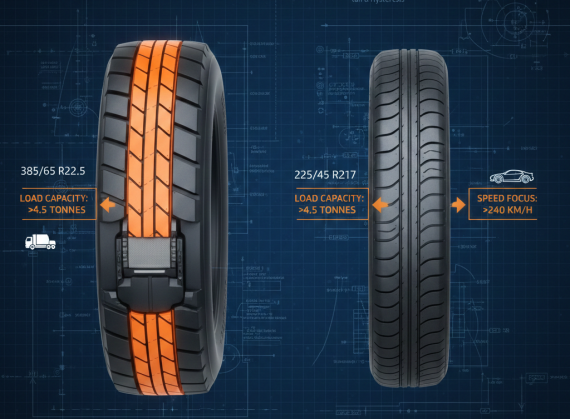 Truck vs Passenger Tyres: Structural Differences, Production Logic, and Regulatory Framework
 Physico-Chemical Foundation: the process mechanismthe operation of any pneumatic tyre is based on the phenomenon of hysteresis, which is a…
Read more Truck Restrictions and Bans in the Netherlands 2026: Emissions, Dimensions, and Time Limits
 The Netherlands holds a key position in European logistics, with the ports of Rotterdam, Amsterdam, and Zeeland connecting the EU…
Read more