

Permissible axle load for trucks in Germany: documents, regulations, calculations, and fines





Exceeding the permissible axle load is one of the most common reasons for fines when driving trucks in Germany. The problem is that even if the vehicle’s total weight complies with the limit, it is still possible to exceed the norm on a single axle — which can lead to restrictions or even a driving ban. To prevent this, it’s important to know how to read data from the Fahrzeugschein (German vehicle registration certificate), how to check load distribution, and which values are legally acceptable. At MT Onroad, we provide only up-to-date information for truck drivers: regulations, calculations, examples, and control rules.
What is axle load and why is it critical for trucks?
The axle weight, meaning the weight distributed on a single truck axle, considers the vehicle’s own weight, cargo, passengers, and any mounted equipment. This load is measured statically at fixed points on the wheels, usually when the vehicle is stationary.
It’s significant to understand that if the cargo is unevenly distributed, one axle may be overloaded even when the vehicle’s total mass is within the legal limit. This means that compliance with the gross vehicle weight shown in the Fahrzeugschein does not guarantee that the truck meets axle load requirements.
To clarify the terminology used in transport documentation and inspections:
- Achslast – load on a specific axle. Measured separately for each axle, with both technical and legal significance. The maximum permissible parameter is stated in the Fahrzeugschein.
- Stützlast – vertical load or drawbar load transferred from the trailer to the towing vehicle through the coupling device. It affects the actual load on the rear axle of the tractor unit and is included in axle load calculations.
- Radlast – the portion of the axle load applied to a single wheel. For example, with an uneven load on the left side of a semi-trailer, the same axle may have different loads on the left and right wheels.
- Nutzlast — payload capacity, i.e. how much weight can be loaded without exceeding the permissible total weight (distribution across axles is not considered here).
- Gesamtmasse total weight of the vehicle in a loaded state, including the vehicle’s own weight, cargo, driver, passengers, and fuel. This is the maximum permissible mass registered in the Fahrzeugschein, but it does not reflect weight distribution between axles.
Axial loads refers specifically to the Achslast parameter, which is checked at inspection points using mobile or stationary scales. Even if the vehicle’s total mass is within the legal limit, an overload on a single axle is grounds for a fine and may result in being prohibited from continuing the trip. That’s why controlling only the gross vehicle weight is not enough.
Where is the axle load limit for a truck listed in the registration documents?
All official information on the permissible axle load is indicated in the Zulassungsbescheinigung Teil I — the document that replaces the traditional “technical passport” in Germany. The specific fields to check are:
- Item 7 — Technisch zulässige Achslast (technically permissible truck axle load) – indicated separately for each axle.
- Item 8 — Zulässige Achslast im Zulassungsmitgliedstaat (legal norm for axle load in the registration country).
- Item L — is the total number of axles of the vehicle.
If the vehicle has more than three axles, data for additional axles may be listed in the comments field or in an annex to the document. For tractors with trailers, the Stützlast (drawbar load) is also specified separately.
It’s important to distinguish between two definitions:
- Technically permissible axle load for a truck – the limit set by the manufacturer and confirmed during vehicle registration.
- Legally permissible axel load – the limit set by German or EU road legislation. If these values differ, the stricter one applies.
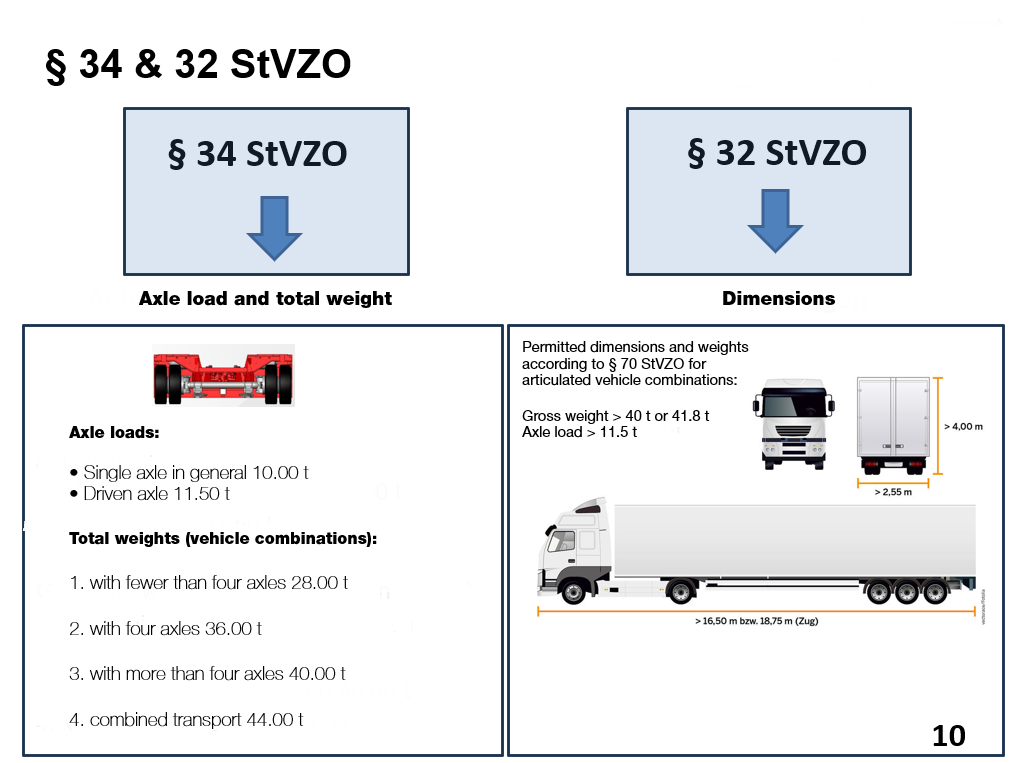
These restrictions apply to axle loads in Europe and are introduced to protect road surfaces. In practice, this is especially relevant for trucks with a gross weight of 38 to 44 tons, where the axle load must be strictly balanced both in documentation and in reality. During roadside checks, BAG inspectors compare the axle weights on a single axle against the data in the Fahrzeugschein and the statutory norms (§34 StVZO).
Permissible axle loads for trucks in Germany under §34 StVZO: official values
In Germany, the legally permissible axle load is regulated by §34 of the Straßenverkehrs-Zulassungs-Ordnung (StVZO). This document specifies the maximum axle load values depending on the type of axle, number of wheels, the distance between them, and the vehicle’s construction.
The permissible values are given for vehicles with pneumatic (or equivalent) suspension and rubber tires.
Axle loads table: current limits for 2025
| Axle type | Condition | Maximum load |
| Single axle | any | 10 t |
| Single drive axle | with single or twin tires | 11.5 t |
| Two-axle group (trailer/truck) | axle spacing < 1> | 11.5 t |
| Two-axle group | axle spacing from 1.0 to < 1> | 16 t |
| Two-axle group | axle spacing from 1.3 to < 1> | 18 t |
| Two-axle group with leading axle (twin tires or suspension equal in performance) | axle spacing from 1.0 to < 1> | 19 t |
| Triaxial group | spacing between all axles ≤ 1.3 m | 21 t |
| Triaxial group | spacing between all axles > 1.3 m but ≤ 1.4 m | 24 t |
These values apply to axle groups as a whole. However, even if the group limit is met, no individual axle in the group may exceed its technical limit stated in the Fahrzeugschein (field: permissible axle load).
When Directive 96/53/EC does not apply: local axle load restrictions for trucks
In Germany and other EU countries, there are exceptions where the maximum permissible axle load may be reduced to 10 tonnes or even lower. Such restrictions are common in the following zones:
1. Bridges and overpasses, especially older structures (including on regional roads):
- Leverkusen Bridge (A1, NRW) – limit of 3.5 t per axle;
- Bridge over the Bode (Quedlinburg, Saxony-Anhalt);
- Autobahn bridge near Worms (A61) – temporary restrictions during repairs.
2. Historic city centres, where road surfaces or underground infrastructure are not designed for high point loads:
- Lübeck Old Town (UNESCO, 7.5 t GVW limit);
- Berlin city centre (around Brandenburg Gate);
- Hamburg’s historic Speicherstadt district;
- LEZ zone in Stuttgart.
3. Water protection zones, where excess loads may affect engineering structures:
- Wasserschutzgebiet Frankfurt Süd (restrictions on A661 and B3);
- Wasserschutzzone Steinhuder Meer (Lower Saxony);
- Wasserschutzgebiet München Nord – entry ban for trucks over 7.5 t.
4. Residential areas with narrow streets and limited load-bearing semi-truck load capacity:
- Prenzlauer Berg, Berlin;
- Südstadt, Hanover;
- Pasing, Munich.
5. Roadworks where temporary reduced load limits are enforced.
6. Environmental zones:
- Stuttgart Umweltzone (city centre and Zuffenhausen);
- Cologne Umweltzone (city centre and Ehrenfeld);
- Berlin Umweltzone – restrictions not only on emissions but also on truck weight.
7. Suburban areas with restricted access for heavy trucks :
- Oranienburg (Brandenburg);
- Local roads in Wiesbaden-Kloppenheim;
- Freising area (entry via B301).
8. Roads with seasonal load limits:
- Forest roads in the Black Forest (Baden-Württemberg);
- Bypasses in agricultural zones of Uckermark (Brandenburg);
- Field roads near Passau (Bavaria) – closed in spring during thaw.
Such local restrictions are always indicated by road signs (Achslastbeschränkung) and must be considered when planning a route. Exceeding the limit, even if the “legal” weight is within the value shown in documents, is grounds for a fine and potentially for a driving ban.
Permissible axle load in Europe: specifics of calculation for trucks and trailers
For tractors with twin tires and air suspension, extended limits apply, especially for drive axles. In this case, the maximum permissible axle load can be up to 11.5 tonnes, which corresponds to the EU regulatory maximum under Directive 96/53/EC.
Trailers with rigid beams and without active load distribution often fall under the 10-ton limit for a single axle, particularly if their suspension does not meet the Luftfederung category or its technical equivalent.
Axle spacing within a group is also considered. The larger the spacing, the higher the permissible axle load:
- 1.3 to 1.8 m between two axles allows up to 18 t;
- spacing over 1.8 m allows up to 20 t for a tandem axle group.
This calculation is reflected in the official axle load table according to §34 StVZO. The permissible axle load is not a simple proportion of the vehicle’s gross weight — not only the weight itself but also its distribution matters.
How to Calculate Axle Load: Main Methods
Axle load control can be done manually, but such calculations only give an approximate idea of weight distribution. The driver mentally divides the truck body into sections, estimates the weight of each, and assumes how much mass falls on each vehicle axle.
In practice, during loading, onboard weighing systems or data from air suspension pressure sensors are more often used — these show the current axle load. Before departure, control is carried out via stationary or mobile axle scales, especially for international transport.
Example 1. Scenario: Full load, 44 tonnes, axle spacing 1.35 m
Let’s say we have a standard vehicle combination: a three-axle tractor with a tandem-axle semi-trailer. The total documented weight is 44 t. The rear axle group of the trailer has an axle spacing of 1.35 m. According to the table in §34 StVZO:
- This tandem axle group is allowed a maximum of 18 t;
- Single axles — up to 11.5 t, if equipped with twin tires and air suspension.
Total:
- Front axle of the tractor — up to 7.5 t;
- Drive axle — up to 11.5 t;
- Trailer axles — maximum 18 t for the pair.
Example 2. Scenario: Load redistribution after partial unloading
At the first warehouse, the driver unloaded several pallets located closer to the middle of the semi-trailer. After this, part of the cargo shifted closer to the front axle. As a result, the load on the front part increased, while the rear load decreased.
Although the total weight remained within the legal limit, the load on the axles (for example, the front axle of the tractor) could exceed the permissible value.
Trailers and trucks with special permits
- Swap bodies trucks
These tractors often have air suspension and twin tires, allowing them to carry up to 11.5 t on the drive axle. - Low-deck semi-trailers
Used for oversized and heavy loads. Due to the increased axle spacing, loads of up to 19 t are permitted for multi-axle bogies if the spacing exceeds 1.8 m. - Long vehicle combinations
Modular combinations up to 25.25 m in length and up to 44 t in weight (within Germany, subject to approval by the federal state authorities). - Tankers and tippers with reinforced suspension
Depending on certification, an axle load of up to 10 t is allowed for each axle without Luftfederung, and up to 11.5 t if the suspension meets the regulation’s requirements. - Short wheelbase trailers with closely spaced axles
If axle spacing is less than 1.3 m, the maximum group load is limited — up to 11 t for two axles, even if the trailer is empty.
Fines for axle overload in trucks
Overloading a truck by more than 2% of the actual total weight or axle load is considered a violation and results in fines for both the driver and the vehicle owner.
According to the Bußgeldkatalog and updated 2025 data:
| Exceeding permissible total weight or axle load | Driver fine | Owner fine | Points |
| 2–5 % | 30 € | 35 € | 0 |
| 5–10 % | 80 € | 140 € | 1 point |
| 10–15 % | 110 € | 235 € | 1 point |
| 15–20 % | 140 € | 285 € | 1 point |
| 20–25 % | 190 € | 380 € | 1 point |
| 25–30 % | 285 € | 425 € | 1 point |
| over 30% | 380 € | 425 € | 1 point |
Unlike passenger cars, for trucks the tolerance for overload is only up to 2%, above which penalties apply. There is zero tolerance for axle overload, and compliance is monitored using mobile axle scales. Fines are the same for exceeding the total weight or the load on a single axle.
Other consequences of violating weight and dimension standards
- Driving ban until unloading or redistributing the cargo.
- Trip cancellation or forced cargo transfer on-site.
- Risk of insurance refusal in case of an accident if the load exceeded the limit.
- Automatic checks when entering Umweltzonen: the system reads the weight and may block entry.
- Additional penalties for systematic violations or in case of accidents causing damage or injury.
FAQ
Can I get a special permit to exceed the axle vehicle load for a specific trip?
Yes, in exceptional cases (for example, when transporting oversized cargo, construction machinery, or for military logistics) it is possible to obtain a Sondergenehmigung — a special permit from local authorities or BAMF. This document specifies the permissible weight parameters, route, and validity period. Without it, entry into populated areas, across bridges, and into LEZ zones with an overload is prohibited.
How can I contest an axle overload fine if the scale readings are questionable?
The driver is entitled to request a re-weighing and obtain a copy of the weighing report. Often, overloads are recorded by mobile scales, and results may depend on road surface evenness, tire pressure, and other factors. Contesting is possible through an Anwalt für Verkehrsrecht (traffic law attorney), especially if the case involves penalty points in Flensburg.
Why can the same tractor model have different permissible axle loads in different EU countries?
Each EU country sets its own legal limits, even if the technical parameters are the same. In Germany, for example, a stricter 10 t limit may apply to a single axle in water protection zones, whereas in Poland or the Czech Republic, the limit can be 11.5 t. Therefore, the zulässige Achslast value must always be clarified according to local laws.

Useful info updates via Telegram Subscribe to the Telegram Bot and get:
- Current news about the traffic situation in Germany
- Emergency help for your truck - just send HELP to the bot
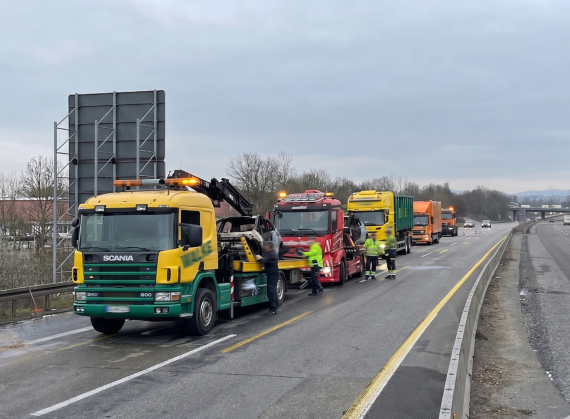 Truck Breakdown and Heavy Recovery in Germany: How Fleet Managers Can Control Towing, Recovery and Costs
 A truck breakdown in Germany is rarely just a technical problem. For fleet managers and dispatchers, it immediately creates a…
Read more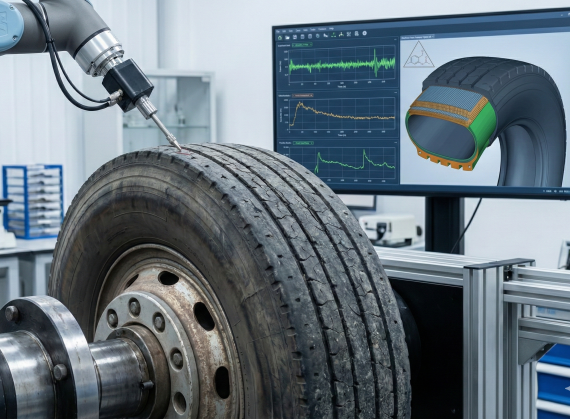 Thermodynamics and tribology of tyre aging: mechanisms of heat generation and structural degradation
 1. Introduction: the tyre as a thermodynamic systemA pneumatic tyre is a sophisticated composite structure designed to operate under extreme…
Read more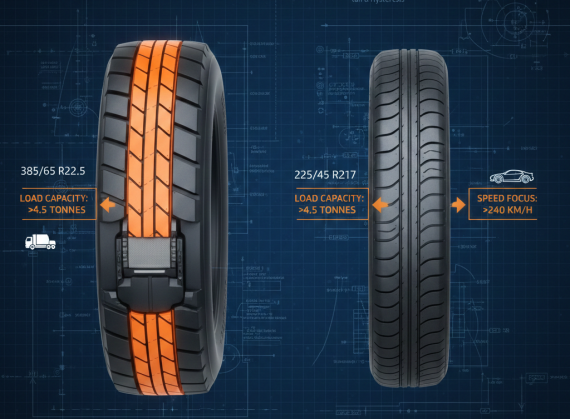 Truck vs Passenger Tyres: Structural Differences, Production Logic, and Regulatory Framework
 Physico-Chemical Foundation: the process mechanismthe operation of any pneumatic tyre is based on the phenomenon of hysteresis, which is a…
Read more