

Overtaking slow trucks on the road: why “elefantenrennen” happens and when it’s allowed





On busy German autobahns, it’s common to see one truck slowly overtaking another — a situation that often frustrates drivers stuck in the left lane. This phenomenon even has an unofficial nickname: Elefantenrennen (elephant race). But behind this colorful term lies a real traffic issue caused by the technical limits of trucks, speed regulations, and poor overtaking strategies. In this article, MT onroad experts explain why overtaking slow trucks can bring traffic to a crawl and when this so-called “elephant race” is actually permitted.
What is elefantenrennen: the technical side of overtaking slow trucks
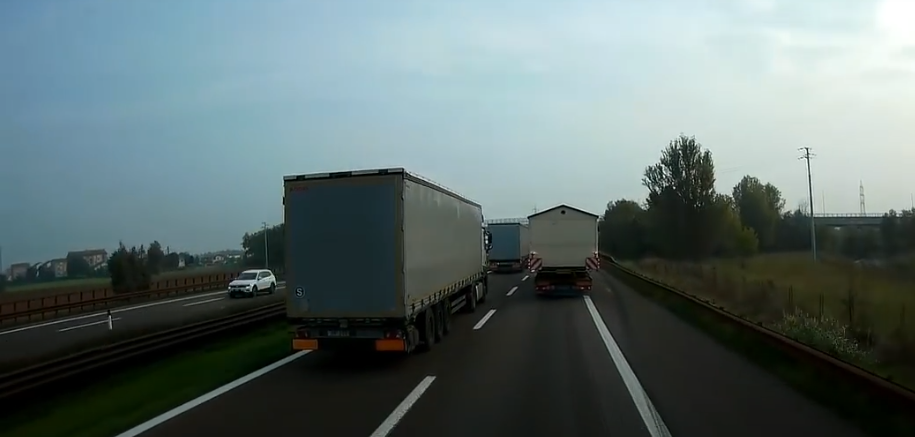
Elefantenrennen, literally “elephant race,” is a German term for what happens when one truck (often with a trailer) slowly overtakes another with only a minimal speed difference — in other words, overtaking slow trucks on the road. Here’s what’s going on behind this:
- Both trucks are usually travelling at about 80 km/h — the maximum speed allowed on German autobahns.
- The speed difference between them is regularly just 1–5 km/h.
- The length of the trucks and the need for a safe side distance make the whole overtaking manoeuvre even longer.
As a result, overtaking slow trucks in these conditions can take anywhere from one to three minutes. During this time, the left lane is blocked, traffic flow slows down, and drivers behind frequently get frustrated.
Why can’t trucks overtake faster?
Even if a truck is technically capable of speeding up, there are strict limits that keep drivers from overtaking quickly:
- Most trucks in the EU are fitted with speed limiters that cap their top speed at around 89 km/h.
- The legal speed limit in Germany is 80 km/h on the Autobahn;
- A heavy load and uphill sections can easily reduce a truck’s ability to accelerate.
In theory, a truck could complete an overtaking manoeuvre faster if it being overtaken slowed down to about 70–75 km/h. But in reality, this rarely happens; both drivers usually stick to their maximum allowed speed. That’s why overtaking between trucks often happens with only a tiny difference in speed, and the driver in the passing lane simply can’t go any faster, even if they'd like to.
Why do trucks still do a slow truck overtake?
This decision isn’t always about stubbornness or impatience — more often, it’s driven by logistics and work regulations. Here are some common reasons why truck drivers choose to overtake, even if it’s slow:
- Keeping up a steady driving pace, especially on long uphill stretches where dropping speed means losing precious momentum.
- Some routes require trucks to maintain a minimum average speed to meet delivery schedules.
- Drivers must follow their fixed driving and rest times according to the tachograph.
So, when a truck driver notices they’re moving just 2–3 km/h faster than the truck ahead, they’ll often decide to overtake rather than brake and lose momentum. This helps them avoid situations where stopping or slowing down too much could make it harder to reach the next planned stop within their legally allowed working hours. At the end of the day, these are fully loaded commercial vehicles with real physical and regulatory constraints — things that drivers of passenger cars often forget when they get stuck behind a slow truck overtake.
How should car drivers handle a truck overtaking race?
The “elephant race” usually happens on two-lane sections of the autobahn. Sometimes, a car driver finds themselves caught between two trucks in the same right lane, just as the rear truck starts to overtake. In this situation, it’s actually easier and safer for the car to slow down and let the trucks complete their manoeuvre. You’ll lose just a couple of minutes, but you can easily make up that time later because cars have better acceleration and fewer speed limits. A few things car drivers should always keep in mind:
- Don’t squeeze in between trucks. The gap between them is there for a reason — it’s calculated for safe distances.
- Never cut in too close after overtaking. Remember, commercial vehicles need much longer stopping distances.
- Avoid honking or flashing your lights. This won’t make the truck go faster — it just adds stress and can lead to dangerous reactions.
- Sometimes, it’s safer to wait for the overtaking to finish than to jump to another lane and get stuck in more traffic.
The best thing you can do? Be patient and let the so-called truck overtaking race finish. It usually only takes a minute or two. As a car driver, your job is to stay calm and avoid making sudden moves that could make the situation worse for everyone on the road.
Why do trucks sometimes end up in the left lane on three-lane autobahns?
Many drivers believe that trucks are always banned from using the left lane — but that’s not entirely true. On three-lane motorways, there are some special rules:
- Trucks should normally stay in the right and middle lanes for regular driving.
- The left lane is allowed when overtaking — but only if there are no signs prohibiting commercial vehicles from passing (look out for sign 277 in Germany).
- During traffic jams, trucks are allowed to move temporarily into the left lane to keep traffic flowing.
It’s also important to remember that truck movements are regulated by extra road signs that car drivers often overlook. So, even if a slow truck overtaking maneuver seems annoying or unnecessary, it’s not always illegal. If the driver follows the rules, they have every right to be there. In the end, Elefantenrennen is a technically driven phenomenon truck drivers rarely do it just because they want to. It’s something they’re often forced to do by speed limits, road conditions, and work schedules. Understanding how and why these slow truck overtakes happen helps all road users stay patient and respectful toward each other — which keeps everyone safer.
In our next blog, we’ll look at where and when trucks are completely banned from overtaking, and what the law says about it.

Useful info updates via Telegram Subscribe to the Telegram Bot and get:
- Current news about the traffic situation in Germany
- Emergency help for your truck - just send HELP to the bot
 Truck Breakdown and Heavy Recovery in Germany: How Fleet Managers Can Control Towing, Recovery and Costs
 A truck breakdown in Germany is rarely just a technical problem. For fleet managers and dispatchers, it immediately creates a…
Read more Thermodynamics and tribology of tyre aging: mechanisms of heat generation and structural degradation
 1. Introduction: the tyre as a thermodynamic systemA pneumatic tyre is a sophisticated composite structure designed to operate under extreme…
Read more Truck vs Passenger Tyres: Structural Differences, Production Logic, and Regulatory Framework
 Physico-Chemical Foundation: the process mechanismthe operation of any pneumatic tyre is based on the phenomenon of hysteresis, which is a…
Read more