

How to Get a Permit to Drive a Truck in Germany on Public Holidays





On public holidays in Germany, a general driving ban applies to trucks with a gross vehicle weight of more than 7.5 tonnes. However, when a delivery cannot be postponed, a carrier may apply for an official permit to proceed — an individual exemption from the existing ban. Such permits are issued under Section 46 of the German Road Traffic Regulations (StVO) and allow a trip to be carried out legally during holiday restrictions. MT Onroad has prepared a comprehensive, practice-based guide explaining when such a permit can be granted, which authorities are responsible, and what documents are required. For the detailed rules governing the bans themselves and the full list of public holidays, please refer to our main guide.
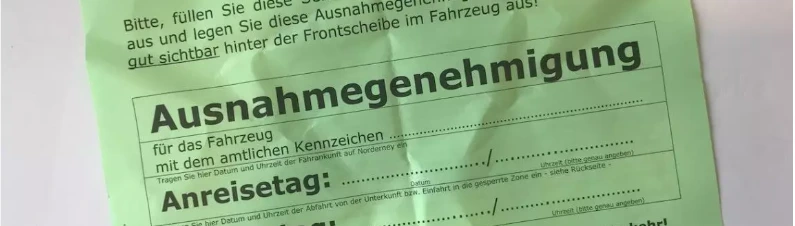
In Which Cases a Permit Is Issued for a Truck to Drive on a Public Holiday in Germany
- Transportation of perishable goods. Trucks carrying perishable products such as fresh fruit, vegetables, meat, and dairy products may be granted permission to drive on public holidays. This ensures that goods remain fresh and are delivered to stores on time.
- Vehicles that are part of combined transport chains, for example, shipments that include rail or inland waterway transport, may also receive an exemption if this improves overall efficiency and reduces environmental impact.
- Vehicles used for emergency response and rescue operations are exempt from holiday driving bans. This ensures that emergency services can operate without delay.
How to Obtain a Permit to Drive a Truck on a Public Holiday in Germany
To obtain permission to drive on a public holiday, the following steps are usually required:
- Identification of the competent authority
First, it is necessary to determine which local road authority is responsible for the area where the transport will take place. This may be a district authority, a city administration, or a specialised traffic authority. - Completion of the application form
Authorities usually provide application forms that can be downloaded from their websites or requested by email. The form must be completed fully and accurately. - Payment of the application fee
A fee may be charged for processing the application. The exact amount and payment method depend on the responsible authority. - Submission of the application
The completed application can be submitted by post or, in some cases, electronically. - Waiting for approval
After submission, the authority reviews the application and decides whether to issue the permit. Processing times may range from several days to several weeks, depending on the complexity of the case and the authority’s workload. - Maintaining contact
It is recommended to provide contact details so that the authority can easily request additional information or clarification if needed.
What Documents Are Required?
The application usually requires the following documents:
- Proof of business registration or an extract from the commercial register
- A description of the transport operation (route, type of cargo, reason for the exemption)
- Vehicle information (registration documents and technical specifications)
- Evidence confirming the necessity of driving during the holiday ban (for example, perishable goods or emergency-related transport)
Can a Foreign Company Obtain a Permit in Germany?
Yes, foreign transport companies are entitled to obtain permits to operate trucks in Germany on public holidays. German legislation does not distinguish between carriers based on the country of registration. The decisive factor is a properly justified need for the journey and correct compliance with the application procedure under § 46 (1) No. 7 of the German Road Traffic Regulations (StVO).
Foreign carriers apply to the same competent authorities as German companies. The responsible authority is determined by the location where the transport begins within Germany or by the region through which the vehicle is scheduled to travel on the public holiday.
When reviewing applications from foreign carriers, authorities typically assess:
- the presence of a clear and well-documented reason for holiday driving;
- a precise and detailed description of the route within Germany;
- the completeness and accuracy of the submitted documents;
- the applicant’s ability to comply with the conditions of the permit (validity period, route, type of cargo).
The absence of company registration in Germany is not a ground for refusal. However, in practice, authorities more often request additional justification from foreign carriers if the transport does not clearly fall under standard exemptions, such as perishable goods or combined transport.
Processing times for applications from foreign companies may be longer. Some authorities accept documents only in German, and in certain federal states applications are accepted exclusively in paper form. For this reason, it is recommended to start the permit application process well in advance, especially if the route passes through multiple federal states.
Which Authorities Issue Truck Driving Permits Depending on the Federal State?
It is important to note that specific requirements and procedures may vary depending on the federal state. Companies should therefore review the relevant information in advance to ensure a smooth application process.
These regulations are set out in the German Road Traffic Act (StVG) and the Road Traffic Regulations (StVO) and are enforced by the Federal Office for Logistics and Mobility (BALM) as well as the competent state authorities. To obtain an exemption, an application must be submitted to the responsible authority. The list of required documents and the conditions for review may vary depending on the region and the specific case.
In Bavaria, exemptions from the truck driving ban and other traffic-related permits are usually issued by local road authorities. These authorities are typically located within district offices or city administrations. Examples include:
- Munich District Office (Kreisverwaltungsreferat), responsible for the Munich district.
- City of Munich (Kreisverwaltungsreferat – KVR), responsible for traffic regulation within the city of Munich.
- Government of Upper Bavaria, which coordinates regional traffic matters and may issue permits in special cases.
To determine the exact competence and application procedure, it is recommended to contact the authority responsible for the area where the transport begins or takes place. The official websites of these authorities usually provide information on application forms and specific requirements.

Useful info updates via Telegram Subscribe to the Telegram Bot and get:
- Current news about the traffic situation in Germany
- Emergency help for your truck - just send HELP to the bot
 Truck Breakdown and Heavy Recovery in Germany: How Fleet Managers Can Control Towing, Recovery and Costs
 A truck breakdown in Germany is rarely just a technical problem. For fleet managers and dispatchers, it immediately creates a…
Read more Thermodynamics and tribology of tyre aging: mechanisms of heat generation and structural degradation
 1. Introduction: the tyre as a thermodynamic systemA pneumatic tyre is a sophisticated composite structure designed to operate under extreme…
Read more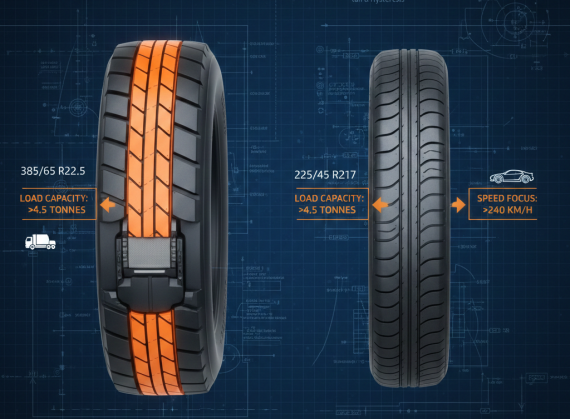 Truck vs Passenger Tyres: Structural Differences, Production Logic, and Regulatory Framework
 Physico-Chemical Foundation: the process mechanismthe operation of any pneumatic tyre is based on the phenomenon of hysteresis, which is a…
Read more