

Germany Truck Driving Ban 2026: Exact Times, Holiday List, Summer Saturday Routes (with Exceptions)





This guide explains Germany’s Sunday and public holiday truck driving ban under §30 StVO and the summer Saturday ban under the Ferienreiseverordnung (Holiday Travel Regulation), including key routes, exemptions, and penalties for 2026.
Key Facts in 30 Seconds
| What Matters | Summary |
| Who is affected | Trucks with a permitted gross weight over 7.5 t and trucks with trailers in commercial transport |
| When it applies | 00:00–22:00 on Sundays and official public holidays |
| Summer regime | 1 July – 31 August, Saturdays 07:00–20:00 on selected motorways and federal roads |
| Official source | Federal Office for Logistics and Mobility (BALM) – Feiertagsfahrverbot 2026 |
| Penalties | Driver – €120, contracting party / responsible entity – €570 |
By European standards, Germany remains one of the strictest countries when it comes to truck traffic. Here, driving bans are not a formality but a real instrument of traffic management. The reason lies in the country’s unique position: Germany is crossed by the EU’s main transit corridors, where the North–South and East–West routes intersect. The pressure on roads, cities, and the environment is therefore far greater than in most neighboring states. As a result, restrictions for heavy vehicles have become a permanent element of everyday infrastructure policy rather than a temporary measure.
In this overview, the MT onroad team has collected and systematized all truck restrictions in force for 2026: weekend bans, public holidays, seasonal restrictions, and legal options for passage. The material is based on current regulations and official sources, to which we have provided direct links. Use this information when planning routes, in dispatcher workflows, and in daily cooperation with drivers. To learn how to obtain permission for a truck to drive on a public holiday, please follow the link to our next blog article.
Legal basis for the truck driving bans in Germany
The German legal framework imposes restrictions on commercial heavy freight transport through a coordinated set of statutory instruments derived from various legislative sources. The primary normative foundation is Section 30 of the German Road Traffic Code (Straßenverkehrsordnung – StVO), which imposes a general operational prohibition on heavy freight vehicles during the weekly rest day and on days officially recognised as national ceremonial observances.
To supplement this foundational regime, the Federal Republic activates the Holiday Season Journey Regulation (Ferienreiseverordnung – FerReiseV) during the extended summer vacation period. This specialised statutory instrument introduces temporary cyclical movement restrictions on Saturdays on designated motorway corridors and primary federal-level roads. The competent administrative entity, the Federal Bureau for Logistics and Mobility (Bundesamt für Logistik und Mobilität – BALM), publishes annual lists of affected road infrastructure segments, applicable time periods, and officially sanctioned exemption classifications. These administrative pronouncements serve as authoritative reference repositories for determining and verifying route plans and the movement restriction frameworks in operation at any given time.
Why do truck driving bans exist in Germany?
Contextual historical narrative: The first implementation of prohibitions on movement from Saturday to Sunday, along with constraints on commercial heavy-vehicle operations on ceremonial dates in German jurisdictions, emerged during the 1950s. What was the underlying policy motivation for this regulatory innovation? The determining factor was the maximisation of road safety and the preservation of peace and tranquillity on the transport infrastructure.
These operational constraints achieve two complementary objectives: they significantly reduce the volume of heavy freight circulation during peak leisure travel periods, thereby improving vehicular flow safety metrics along Germany's busiest transport corridors. Consequently, these limitations facilitate and increase private leisure vehicle circulation and tourism sector transportation flows, while simultaneously establishing enhanced safety conditions during periods of exceptionally high concentrations of holidaymakers and recreational travellers.
Truck driving bans in Germany 2026: when can restrictions apply?
Within the German regulatory domain, prescriptive restrictions affecting commercial freight vehicle operations primarily focus on weekly rest periods, public holidays and the summer Saturday operational regime.
How the situation looks on weekends:
- Movement restrictions in Germany activate on Sundays and official public holidays from 00:00 to 22:00 hours. This establishes comprehensive vehicle-movement interdiction spanning nighttime and daylight periods through late evening. However, the German jurisdiction does not maintain a universal nighttime prohibition across all road infrastructure. Evening and early-morning constraints apply exclusively to specified road segments or under local regulatory ordinances.
- Throughout the extended summer tourism season, additional operational movement restrictions come into effect. From 1 July to 31 August, a total ban on heavy freight vehicle circulation is in place on the sixth weekday (Saturday), from 07:00 to 20:00. This restriction affects certain sections of the federal thoroughfare network, facilitating route optimisation to minimise operational downtime and unnecessary vehicle idleness.A full list of roads where truck driving bans apply in Germany in 2026 is available on the Ferienreiseverordnung website — the complete list of routes subject to the summer ban.
Not only on weekends, but also on certain public holidays, truck driving bans in Europe come into force. In Germany, this applies only to official public holidays, regional holidays, and specific roads.
Do these strict rules apply to all trucks?
After analyzing the situation, we found that they do not. For certain freight transport categories, the comprehensive framework prohibiting truck movements within German jurisdiction in 2026 does not impose operational constraints. These vehicles are authorised to circulate on Saturdays, Sundays, public holidays, and throughout the summer without time restrictions. Such authorised operations encompass freight vehicles:
- Conveying time-sensitive organic foodstuffs, including lactose-derived dairy products, aquatic fauna, marine organisms, processed animal protein commodities, vegetable-derived substances, and tree fruit agricultural products.
- Engaged in the conveyance of living bee colonies and apiarian operations, supporting agricultural pollination services and beekeeping enterprises;
- Operating as an emergency response and critical intervention apparatus, encompassing paramedical services, catastrophic event mitigation and casualty management operations.
Operational exemptions also apply to multimodal logistics configurations, where merchandise delivery operations within a single journey itinerary utilise different modes of transportation, with transfer point timing connections requiring stringent coordination. These logistical configurations include rail-to-road and maritime-to-road integrations.
Traffic ban: truck driving restrictions in Germany on public holidays 2026
In Germany, the ban on truck traffic on public holidays is not regulated by a single list of dates, but by the status of the holiday — federal or state-level. Federal public holidays are dates officially recognized across the entire territory of Germany. On such days, the truck driving ban applies nationwide, regardless of which federal state the route passes through.
Nationwide Public Holidays 2026 (the ban applies throughout Germany)
On the subsequent calendar dates, §30 StVO-mandated operational prohibition applies uniformly across all German jurisdictions to freight vehicles >7.5 t and truck-trailer configurations in revenue-generating operations:
| Date (2026) | Public Holiday | Status | Where the Ban Applies | Ban Hours |
| 01 Jan 2026 | New Year’s Day (Neujahr) | Nationwide | Entire Germany | 00:00–22:00 |
| 03 Apr 2026 | Good Friday (Karfreitag) | Nationwide | Entire Germany | 00:00–22:00 |
| 06 Apr 2026 | Easter Monday (Ostermontag) | Nationwide | Entire Germany | 00:00–22:00 |
| 01 May 2026 | Labour Day (Tag der Arbeit) | Nationwide | Entire Germany | 00:00–22:00 |
| 14 May 2026 | Ascension Day (Christi Himmelfahrt) | Nationwide | Entire Germany | 00:00–22:00 |
| 25 May 2026 | Whit Monday (Pfingstmontag) | Nationwide | Entire Germany | 00:00–22:00 |
| 03 Oct 2026 | German Unity Day (Tag der Deutschen Einheit) | Nationwide | Entire Germany | 00:00–22:00 |
| 25 Dec 2026 | Christmas Day (1st Day of Christmas) | Nationwide | Entire Germany | 00:00–22:00 |
| 26 Dec 2026 | Second Day of Christmas | Nationwide | Entire Germany | 00:00–22:00 |
State Public Holidays 2026 (the ban applies only in the listed federal states)
In the states listed below, the same regime under §30 StVO applies (typically from 00:00 to 22:00). However, for the combination of 31 October (Lower Saxony) and 1 November (North Rhine-Westphalia), officially established relaxations are in force (see the note below the table).
| Date (2026) | Public Holiday | Federal States Where the Day Is a Statutory Holiday | Ban Hours |
| 06 Jan 2026 | Epiphany (Heilige Drei Könige) | Baden-Württemberg, Bavaria, Saxony-Anhalt | 00:00–22:00 |
| 08 Mar 2026 | International Women’s Day | Berlin, Mecklenburg–Western Pomerania | 00:00–22:00* |
| 04 Jun 2026 | Corpus Christi (Fronleichnam) | Baden-Württemberg, Bavaria, Hesse, North Rhine-Westphalia, Rhineland-Palatinate, Saarland | 00:00–22:00*** |
| 15 Aug 2026 | Assumption Day (Mariä Himmelfahrt) | Saarland; Bavaria (in selected municipalities) | 00:00–22:00* |
| 31 Oct 2026 | Reformation Day | Brandenburg, Bremen, Hamburg, Mecklenburg–Western Pomerania, Lower Saxony, Saxony, Saxony-Anhalt, Schleswig-Holstein, Thuringia | 00:00–22:00** |
| 01 Nov 2026 | All Saints’ Day (Allerheiligen) | Baden-Württemberg, Bavaria, North Rhine-Westphalia, Rhineland-Palatinate, Saarland | 00:00–22:00** |
| 18 Nov 2026 | Day of Repentance and Prayer (Buß- und Bettag) | Saxony | 00:00–22:00 |
| 20 Sep 2026 | Children’s Day (Weltkindertag) | Thuringia | 00:00–22:00* |
* If a public holiday falls on a Sunday, the standard Sunday driving ban applies in full (00:00–22:00). Legal basis: §30 StVO and official clarifications issued by BALM.
** For Reformation Commemoration (31 Oct) in Niedersachsen and All Saints' Day (01 Nov) in Nordrhein-Westfalen, administratively-coordinated relaxations establish operational windows from 06:00–22:00 rather than the standard 00:00–22:00, alongside designation of specific transit-corridor exemptions. Detailed information on the affected road sections is published in the respective state decrees (Erlass) and on the BALM Feiertagsfahrverbot 2026 page.
*** For Corpus Christi, certain municipalities – particularly in Sachsen and Thüringen – may designate local observance status; such routes necessitate jurisdiction-specific verification.
Because the status of public holidays in Germany is determined at the level of the federal states, the same calendar day may be a regular working day in one part of the country and a day subject to a truck ban in another. When transiting through multiple states, the route must therefore always be checked separately for each of them.
To verify the current holiday status by state, the following sources can be used: §30 StVO (Gesetze im Internet), the Federal Office for Logistics and Mobility (BALM), the German Trade Union Confederation (DGB), the ADAC, as well as state-level holiday calendars (such as Sonntagsblatt, visitBerlin, and Ferienwiki).
Truck driving bans in Germany in 2026: which roads are affected?
From 1 July through 31 August 2026, Saturday-specific constraints (07:00–20:00) activate on the subsequent high-capacity corridors:
- A1 (Baltic Sea Corridor): Lübeck interchange–Puttgarden terminus
- A3 (Western European Transit Route): Oberhausen interchange–Cologne-East interchange
- A5 (Rhine Valley Corridor): Hattenbach interchange – Frankfurt/Main interchange
- A6 (Southwest-Northeast Axis): Mannheim interchange – Nuremberg interchange
- A7 (Hamburg-Munich Artery): Hamburg interchange – Flensburg interchange
- A8 (Munich-Switzerland Passage): Karlsruhe interchange – Salzburg terminus
- A9 (Munich-Prague Corridor): Munich interchange – Nuremberg interchange
- A10 (Berlin Metropolitan Ring): Berliner Ring (complete circuit)
- A45 (Ruhr-Frankfurt Connector): Dortmund interchange – Aschaffenburg interchange
- A61 (Rhine-Westphalia Thoroughfare): Mönchengladbach interchange – Ludwigshafen interchange, plus additional segments.
Unlike the summer Saturday truck driving ban on European roads, which applies only to specific sections, Sunday restrictions apply to:
- Every motorway segment (A1–A99 and additional facilities).
- Every federal thoroughfare designation (including B1, B6, B27, B96, and continuous enumeration).
- All state-level, regional, and county-level road infrastructure.
What fines can be imposed for violating truck driving bans?
Based on information from open sources and the experience of our clients, violations of truck driving bans can result in significant fines. Our analysis of the German fine catalogue for trucks in 2026 shows that in the event of a violation, the driver faces a fine of 120 euros, while the party ordering and paying for the transport is required to pay a fine of 570 euros.
The amounts of fines for violating truck driving bans are set out in the official German fine catalogue (Bußgeldkatalog, BKatV) and are applied within the framework of Section 30 of the StVO, depending on the role of the transport participant.
We conclude that it is better not to violate these rules, and that restrictions on weekends and public holidays should be reviewed in advance. If a problem arises with a truck on any route in Germany, please contact MT onroad roadside assistance. We operate 24/7, provide consultations, help organize communication with BALM, resolve repair issues, and, if necessary, can provide mobile truck repair.
Exceptions to the restrictions
Despite the strict rules, there are certain exceptions for trucks transporting specific types of goods or performing special tasks. Trucks are exempt from restrictions in the following cases.
1. Transportation of perishable food products
- Trucks transporting perishable food products such as dairy products, fish and seafood, meat, vegetables, and fruit are exempt from restrictions.
- This is necessary to ensure uninterrupted delivery of food products that require special storage and transport conditions in order to prevent spoilage.
- Dairy products. Milk and dairy products must be stored continuously under refrigerated conditions. Interruptions in delivery can lead to significant losses and consumer dissatisfaction.
- Fish and seafood. These products are particularly sensitive to temperature fluctuations and delivery times, which makes timely transport essential.
- Meat. To maintain meat quality, strict storage and transport conditions must be observed, which requires uninterrupted delivery.
- Vegetables and fruit. The freshness of vegetables and fruit directly affects their taste and nutritional value, therefore strict delivery deadlines must be observed.
2. Transportation of live bees
A separate category applies to the transport of live bees, which is also exempt from restrictions. Bees require specific transport conditions to remain alive and active.
3. Emergency and rescue vehicles
Vehicles used for emergency and rescue operations and first aid services are exempt from driving bans. These include:
- Ambulances. For rapid medical assistance and evacuation of injured persons.
- Emergency and rescue vehicles. For quick response in emergency situations such as fires, floods, and other natural disasters.
- Critical infrastructure service vehicles. For the rapid provision of essential services such as water supply, electricity, and gas supply.
4. Combined transport
Trucks involved in combined transport may also be exempt from restrictions. This often applies to transport operations in multimodal transport, where timely connections with other modes of transport, such as rail or sea transport, are critical. Delays in such cases can lead to significant disruptions in logistics chains. For combined freight transport carried out as part of non-commercial operations or free-of-charge transport, journeys are permitted to or from a loading or unloading terminal within a distance of up to 200 km. Journeys to or from a loading or unloading port within a distance of up to 190 km are also permitted, provided that these journeys are not commercial or paid transport.
5. Other exceptions
In addition to the exceptions mentioned above, Section 35 of the German Road Traffic Regulations (StVO) and the list issued by the Conference of Transport Ministers define additional exemptions from the Sunday truck driving ban. These rules exempt:
- vehicles of the fire service, police, federal police, the German armed forces, disaster relief services, customs authorities, road services, public administration, and NATO forces;
- self-propelled special-purpose machinery.
Reasons for the exceptions
The main purpose of truck driving bans on weekends and public holidays is to ensure road safety and reduce the load on infrastructure. However, the above-mentioned exceptions were introduced to maintain uninterrupted supply of essential goods and to enable rapid response in emergency situations. These exceptions help ensure stable supply of goods and services for both the population and businesses.
Special permission for Sunday driving 2026
Drivers whose vehicles do not fall under the general exemptions from truck driving bans may apply for a special permit in accordance with Section 46 (1) No. 7 of the StVO. This is done through the relevant road authority in the area of loading or at the place of residence or registration of the company. The application must be submitted in writing and usually requires copies of vehicle documents. Permits are typically granted only for urgent, time-critical transports and not merely for economic reasons. Driving without a permit may result in fines of 120 euros or 570 euros, depending on the severity of the violation.
Route planning with consideration of exceptions
When planning routes, it is important for drivers to determine in advance whether their cargo qualifies for an exemption. This helps avoid fines and delays. Various sources provide up-to-date information on driving bans and exemptions for specific dates and regions, including official authority websites, mobile applications, and online services for drivers.
Understanding and complying with truck driving regulations in Germany is essential for safe and efficient transport operations. Exceptions for certain types of transport help maintain necessary supply chains and enable rapid response in emergency situations. To avoid fines and delays and to ensure uninterrupted vehicle operation, drivers and transport companies are advised to carefully study the applicable rules and plan their routes taking possible exemptions into account.
Where to find up-to-date information on truck driving bans in Germany in 2026?
For verified, real-time regulatory-status information pertinent to 2026 freight-movement restrictions, the subsequent sources are recommended:
- Federal Logistics and Mobility Office (BALM) is the primary administrative source that disseminates definitive determinations concerning operative driving prohibition zones and exemption modalities.
- Trafficsban.com is a Europe-wide platform providing multi-jurisdictional restriction overviews and real-time updates, including Germany-specific documentation.
- For-Driver.info — publishes current country-by-country operational summaries with precise time-window limitations and affected-jurisdiction enumeration (typically on a weekly basis).
All of these sources can be confidently used for preliminary route planning. However, when preparing for an actual trip, it is recommended to verify the current information at least 48 hours before departure with the authorities of the relevant federal state (or country), or to seek consultation from our company.
FAQ
What is considered commercial transport?
Any logistics movement that is part of business-sector economic activity, whether for monetary remuneration or as part of an enterprise's own material conveyance operations (e.g. the retail sector's distribution of goods manufactured by the enterprise).
Does the ban apply to “empty runs”?
Unloaded vehicle movements constitute circumstances that trigger coverage when they are an integral part of commercial logistics operations (e.g. repositioning to alternative operational sites, transit to and from loading facilities, and return-to-depot transit).
Do public holidays need to be checked separately for each state when transiting?
Yes, identical calendar designations may have different operational implications depending on the state-level determination. Consequently, the ceremonial status requires independent verification for each jurisdictional segment along the proposed route.
Is it permitted to drive if the tractor unit is under 7.5 t but a trailer is attached?
No. The ban is based not only on weight but also on vehicle configuration. A truck with a trailer falls under the driving ban in commercial transport regardless of the tractor unit’s permitted gross weight.
Is a CMR waybill sufficient to prove entitlement to an exemption?
In most cases, yes; CMR agreements and related transport documentation constitute the evidentiary foundation for cargo-category certification. If such documents are missing, the driver risks being deemed in violation during roadside inspection.

Useful info updates via Telegram Subscribe to the Telegram Bot and get:
- Current news about the traffic situation in Germany
- Emergency help for your truck - just send HELP to the bot
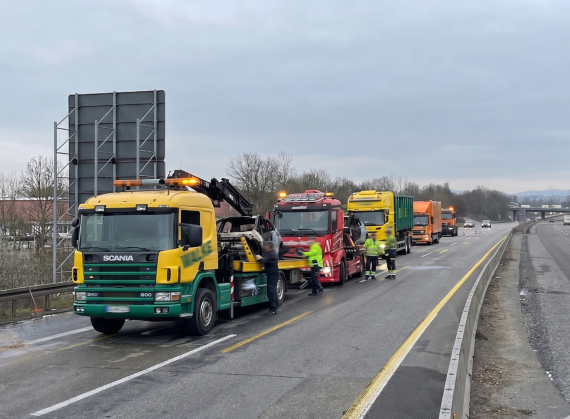 Truck Breakdown and Heavy Recovery in Germany: How Fleet Managers Can Control Towing, Recovery and Costs
 A truck breakdown in Germany is rarely just a technical problem. For fleet managers and dispatchers, it immediately creates a…
Read more Thermodynamics and tribology of tyre aging: mechanisms of heat generation and structural degradation
 1. Introduction: the tyre as a thermodynamic systemA pneumatic tyre is a sophisticated composite structure designed to operate under extreme…
Read more Truck vs Passenger Tyres: Structural Differences, Production Logic, and Regulatory Framework
 Physico-Chemical Foundation: the process mechanismthe operation of any pneumatic tyre is based on the phenomenon of hysteresis, which is a…
Read more